Tuesday, November 6, 2007

Atlas Fragged

Still on the subject of the Atlas Shrugged movie, RandZapper discovered a delightfully clueless report on the film, filed by longtime Objectivist Bob Bidinotto in July of 2006. The report shows up in the archives of the Laissez Faire Books website, but for some reason the page can be accessed only in Google's cache.

Posted on 7/13/06, the LFB entry breathlessly announces that Atlas will soon be a Super Duper Major Motion Picture. According to Bidinotto, who has all kinds of ultra-exclusive Grade A inside dope:

The plan is for the film to be shot and shown in three parts, as a trilogy, like "Lord of the Rings." Only that length, they said, would give sufficient scope to tell Ayn Rand's long, complex story. (The initial $40 million would go mainly to Part I.)...
Oops. Well, that part of the master plan seems to have fallen by the wayside, as there is now no hint of a three-part Atlas, but only a single two-and-a-half-hour snoozefest. Which is obviously just as well, since Lord of the Rings was a colorful, fast-paced story of heartwarming characters and fabulous monsters, while Atlas is a tedious ideological screed stocked with cardboard heroes spouting Randian cliches as they sit around their offices watching their profits shrink. Nobody but the most brain-dead Randroid is gonna pay to sit through nine hours of that.

But ... if "only that length" would do justice to Atlas, then can we assume that the producers now concede that the new slimmed-down movie will not do justice to the book?

LFB continues with its scoop:

The first draft of the script for Part I has been completed by James V. Hart, a veteran screenwriter among whose major credits are "Contact," "Hook," and "Tuck Everlasting."
Hart's script was promptly filed in the shredder, and a new screenwriter, Randall Wallace of Braveheart fame, was hired. It seems a natural choice. He has the word Rand in his name, just like Nathaniel Branden. And having worked with Mel Gibson, he's used to dealing with crazy people.

Philosopher David Kelley -- founder, past executive director, and now Senior Fellow of The Atlas Society (formerly The Objectivist Center) -- has worked closely with Hart to insure the screenplay's philosophical fidelity to the novel.... [Kelley] rates the screenplay about an "8" out of a possible "10."
That's the screenplay they trashed, remember.

The [producers] revealed that they have been deluged with major stars who want to play in the film.
Deluged with major stars, are they? Well, more than a year later no other "major stars" have been attached to the project, so can we assume that the deluge has slowed to a trickle?

While they were eager to hear our suggestions for various characters, the only name they emphasized, repeatedly, was Angelina Jolie for the Dagny role. They made it very clear that Jolie wants to play Dagny very, very much -- and that other actresses (e.g., Ashley Judd), while possibly excellent for the part, might not have the stellar box-office appeal that would allow the film to be a huge success, especially abroad....
RandZapper pauses for the laughter to subside. Jolie has "stellar box-office appeal"? In what star system, Alpha Centauri? In our solar system, the only profitable live-action flick Jolie has made in the last six years was Mr. and Mrs. Smith, co-starring Brad Pitt. It reaped a very healthy $186,336,279. Other than that, here is the dishonor roll of Angelina's big-screen flops since 2001:

Her most recent film, the star vehicle A Mighty Heart, grossed a pathetic $9,176,787.

The Good Shepherd managed to rake in $59,908,565, probably still not enough to cover production and advertising costs.

The laughable Oliver Stone epic Alexander amassed only $34,297,191.

Jolie did manage to make a profitable movie in Shark Tale - $160,861,908 - but since this animated kiddie film only relied on her vocal talents and was aimed at tiny tots, we're not sure it counts.

How about the retro sci-fi flick Sky Captain and the World of Tomorrow? $37,762,677.

The serial killer chiller-thriller Taking Lives, another star turn for Angelina? $32,682,342.

Something called Beyond Borders, which we have never heard of: $4,430,101.

The sequel to Tomb Raider, called Lara Croft and the Cradle of Life - a disappointing and unprofitable $65,660,196. The sequel's poor performance killed the once-promising franchise stone cold dead.

Another nobody-has-ever-heard-of-it movie, Life, or Something Like It: $14,448,589.

And yet another exercise in instant obscurity, Original Sin: $16,534,221.

We're now back to 2001, and the glory days of the first Tomb Raider and the car-heist movie Gone in Sixty Seconds, both of which scored north of a hundred million bucks. Jolie had box office appeal in 2001, no doubt. But since then? Slim pickings indeed.

This is the "major star" who's going to shoulder the burden of making a stupefying yawner like Atlas Shrugged into a money-making venture? Good luck with that.

But really, none of this matters - since, as LFB informs us:

Relative star status is probably being overstressed in the minds of the moviemakers. If the movie is done well, it's going to be a box-office juggernaut no matter, world-wide.
Hell, yeah! A box-office juggernaut, just like the political juggernaut of the Ron Paul campaign!

These sad, clueless bastards really do believe there's a vast audience of Randinistas out there just waiting to see the greatest novel in history, written by the greatest thinker in history, turned into the greatest movie in history.

Here is RandZapper's prognostication. The movie will open big because of the book's notoriety and the long lines of Rand fanatics who will sally forth from their parents' basements to show up on opening night. It will quickly fizzle, killed by murderous reviews, toxic word of mouth, and general public indifference to all things Randian. Within a month it will be a punchline, not unlike the Bennifer bomb Gigli (domestic gross: $6,087,542). Comparisons to Plan 9 from Outer Space will proliferate. And Rand will be even more of a joke than she already is (if such a thing is possible).

For all these reasons, RandZapper wishes the producers success in getting this turkey off the ground. It could be the final embarrassment for Objectivism, the massive self-detonating bomb that will end the Randist movement for good.

---

Update (11/20/07): Jolie's string of box office misfires continues with the overhyped Beowulf, which underperformed expectations on its opening weekend and seems primed to tank, big-time.

Monday, November 5, 2007

The Wisdom of Netflix Users

Lately there have been reports that the much-delayed movie version of Atlas Shrugged may be underway at long last. The producers have apparently enticed international baby-adopter/all-around nutjob Angelina Jolie to play the role of Dagny Taggart, the quasi-female protagonist of the apocalyptic story. Given Jolie's box-office track record of mega-bombs, it's hard to see why casting her in the lead role constitutes any sort of inducement for the money men to pony up the big bucks needed to finance this project, but as P.T. Barnum once said, "There's a sucker born every minute!"

On the eve of the dramatization of Rand's magnum opus, we at RandZapper thought it would be worthwhile to look at the last time Hollywood tackled one of her books. This was back in 1948, when The Fountainhead made it to the big screen, with the way-too-old, slow-talking Gary Cooper incongruously cast as young, dynamic architect Howard Roark, Patricia Neal going all melodramatic as crazy aspiring rape victim Dominique, and Raymond Massey doing his best to preserve his dignity as newspaper tycoon Gail Wynand. Rand herself penned the screenplay, refusing to allow any changes to her deathless prose.

Those unfortunate enough to have seen the resulting turkey know that it consists of embarrassed actors delivering stilted dialogue on expressionistic sets. Roark's "brilliant" architectural creations look like something an autistic preschooler might model out of dog poop. The mood varies from the lugubrious to the ridiculous. Frequent references to "the mob" (meaning ordinary folks) give the film a disturbing fascist air, despite the paean to individualism in the courtroom climax.

But don't take our word for it. Let's see what some of the ordinary folks - i.e., the mob - who rented this abortion on Netflix have to say about it. The most salient observations have been rendered in bold for your reading enjoyment.

So bad it's good. I am a huge Cooper fan, and came to this movie with no idea of what to expect. The lunacy of Ayn Rand's philosophy seems kind of creepy in a post 9/11 world. Blowing up a building to protest its architecture is really not something a likable or even sane character in a film should do. The plot is ridiculous and overblown, and the dialogue beyond trite and laughable.

This movie is truly awful, but entertaining and very compelling in its badness. When I first saw it, within 5 minutes I knew this was a stinker, but with every scene it keeps getting more absurd. So much so that I had to keep watching it to so how profoundly lousy it could get. It's the "Plan 9" of dramas. I don't have the time or energy to list all of the ridiculous plot points, dialogue and directing faux pas. My suggestion: watch this with friends and do a shot every time something idiotic happens or a character makes an overblown speech. You'll be trashed by the end of the flick and have a lot of laughs.

Occasionally interesting, mostly absurd, it highlights the strengths and weaknesses of Rand and her Objectivist worldview. It argues eloquently for freedom and individual achievement, but its absolute disdain and hatred for "mediocrities" borders on frightening as it seems to argue that the only point to their existence is as little more than cattle. What really sinks this movie, however is its absurdly, over the top melodramatic tone and almost religious worship of beauty and achievement. It's like a big, campy, philosophical soap opera.

It's full of ludicrously didactic speeches (by Ayn Rand herself) and mismatched performances (Neal's "expressionist" performance v. Cooper's exhausted naturalism). It is not a forgotten masterpiece, as some have claimed, but it is endlessly fascinating. Rand attempts to align Nietzsche (Roark = Nietzschean superman) with capitalism, as well as modernist architecture. Yet for all its attacks on the masses and mob mentality, the film seems to want us to submit to (to worship) the charisma and force of the male protagonist. How is this not unlike what the National Socialists attempted by claiming Nietzsche as a precursor to fascist ideology? Note, in particular, the final shot and its jaw-dropping symbolism: Roark astride the world's tallest skyscraper as the camera (simulating the POV of Dominique) slowly makes its ways towards his outstretched legs? You might think my write-up a bit exaggerated -- but wait until you see the film! My review is modest in comparison!!

It plays like a trailer, just showing off the highlights in Rand's novel. The music cues are so sledgehammer they end up being hilarious.

Phallus phallus phallus phallus phallus. The moral of the story: if you stick to our guns, you can have the biggest phallus in New York City.

Ayn Rand was a facile writer, and she's sometimes fun to read. But anyone who takes her at her own self-evaluation, as a philosopher -- nay, as a prophet -- has his head jammed where the moon don't shine.

As written philosophy, Rands work is at times compelling while in the end it rings hollow as a workable life philosophy. As theatrical art, Rands work is laughable. Most of the characters in the movie are one dimensional caricatures of Rands vision of good and evil. The only character that has a modicum of true character development is the publishing magnate, Wynand. His inability to maintain Rands view of purity and ultimate self-destruction seem the most human of all the characters. The monologues by the characters, while at first entertaining in its in-your-face manner, quickly becomes tiresome. Overall, this movie hits you on the head with a bat when a more subtle approach would have been more appropriate.

Irritating and bizarre. The novel has a sense of humanity -however marginal - that the film utterly and completely fails to convey. The film also fails to explore the dynamic between Peter Keating, Dominique Francon and Howard Roarke that makes the novel so powerful. Ayn Rand is a better novelist than she is a philosopher and, unfortunately, this film busies itself too much with Rand's Objectivist indulgences rather than just telling the story.

One of the funniest movies I've ever seen. Right up there with Mission Impossible 2 for the greatest all time unintentionally funny films of all time.

What the h#*l was this all about? Ms Rand's philosophical posturings here are ludicrous. The only person who'd enjoy this would be George Costanza who is in to architecture (oh, and importing/exporting and marine biology, of course). It was interesting as a look at a strange point in time when people actually took this story seriously but as entertainment well, the elevator came nowhere near the top floor.

Simply put: it is a mess. There is a point being made here, and that point takes over the plot, overriding any common sense or real drama. Most of the acting and dialogue in the film is very fake. It sounded like a high school kid trying to be a drama major wrote it. Almost every word spoken is stilted and cliched. The music is awful. It tries so hard to tell the story that it is distracting. Patricia Neal walks into the room, and DA DA DA DA, BOOM! It becomes kind of silly after awhile. All this adds up to a movie so melodramatic that you start to laugh. The movie is dead serious, and you're cracking up!

Whole sections of the text are spouted almost verbatim by the characters. And even from the mouths of several truly great actors, the dialogue is at turns mawkish, didactic and always tedious.

Stunningly awful: cardboard characters endlessly spout cliched dialogue in the service of a silly plot. Ayn Rand's screen adaptation of her novel stuffs so much of her very own loopy philosophy into this movie that only true-believing movement conservative types will find any humanity in it.

The dialogue and acting are so over the top that it is comedic. The final scene had us roaring with laughter.

Ayn Rand has some literary talent I will grant you, but as a philosophical tract this movie is positively awful. Very warped view of humanity.

This film is seriously unbelievable. While the architect may have some skills as an architect, he's a horrible leader and is unable to convince anyone to look at things his way. His lack of negotiation and leadership skills squanders what talent he has, making him egocentric, annoying and ultimately a failure. What confuses the heck out of me is that I think the author and director want us to side with him. How can anyone?

Sanctimonious malarkey. Wooden acting. Unlikeable characters.

Haven't laughed that hard in a long time--a five star comedy! Hilarious!

And, oh yes, there were a few - a very few - positive reviews from brainwashed Randolators blown away by the genius of it all. These people really do need to get out more.

RandZapper looks forward to reading the reviews of Atlas Shrugged when it opens in '08 or '09. We suspect they will be very similar to the ones above.

Angelina, baby, you'd better get busy and adopt some more kids. 'Cause when the notices come in on this flick, you're gonna need all the comfort you can get.

Wednesday, October 10, 2007

You Don't Look a Day over 49

Today, Wednesday, October 10, 2007, is the fiftieth anniversary of the publication of Atlas Shrugged, the gargantuan novel that launched the Objectivist movement.

Robert Bidinotto blogs about a dinner held in the book's honor. Surprisingly, many of the participants appear to have been adults. Some may even hold jobs, though this has not been confirmed.

Naturally on this special occasion we will hear many effusions of praise from loyal Randians, starting with Bidinotto himself, who declares that the book's issuance represents "a milestone in human literature, philosophy, and achievement."

Hmm. Literature? Doubtful. Philosophy? More than doubtful. Achievement? Well, the damn thing is really long!

Bidinotto also includes a photo of himself with Barbara Branden, confessing that when the shot was snapped, he was "still misty-eyed over her extraordinary tribute to Rand."

Careful, Bob! Emotions are not tools of cognition!

Ah, but we forget. Emotionalism of the most cloying kind is permitted in one and only one Randian context - tributes to the greatness, the genius, the sheer awesomeness of Ayn Rand herself. As Murray Rothbard incisively observed lo these many years ago, Randism is comprised of an exoteric and an esoteric teaching. The exoterica consist of individualism, capitalism, reason, selfishness, and all that good stuff. The esoteric teaching - the heart of the beast - consists of one tenet and one tenet only: "Ayn Rand is the greatest person that has ever lived or ever shall live."

On this semicentennial, no doubt many Randinistas will be moved to pontificate on how brilliantly their favorite novel (and for many, the only novel they've read since high school, except maybe for The Fountainhead) predicted the future. Look around us, they will cry. See how it all came true, just as Ayn in her infinite wisdom foretold! Then they will say something about high taxes and collapsing bridges.

But let's take a closer look. Here are a few political, economic, cultural, and other developments that Atlas failed to foresee:

A period of prosperity commencing in the late '50s and continuing, with only minor downturns, until the present day. (Atlas foresaw a Great Depression.)

The information revolution - personal computers, the Internet, and loathsome little blogs like this one. (In Atlas, people are still banging away on typewriters and getting their news from newsreels.)

The outsourcing of basic manufacturing industries to Third World countries, and the rise of a service- and information-based economy. (Sayonara, Rearden Steel.)

The eclipse of rail travel by the airline industry, and the eclipse of cargo trains by the trucking industry. (Happy trails, Taggart Transcontinental.)

The ubiquity of television. (Galt's speech is broadcast mainly on the radio. There is a passing reference to television, but TV does not play any role in the story. This is especially odd since TV was already well established by 1957.)

Americans' mass immigration to the Sunbelt and the West. (In Atlas, all the financial and commercial action is in New York City and its surrounds. The West is a lot of open desert, suitable for running train tracks through. Colorado is so empty that a whole valley can be hidden there, unknown to the outside world. The South does not appear to exist at all.)

New directions in science. (Gene-splicing, quantum theory, string theory or any equivalents are absent from Atlas, which presents a scientific community still mired in Newtonian assumptions.)

The demise of hats. (Nobody wears hats anymore. In Atlas, everybody does.)

Now, suppose someone had told Ayn Rand fifty years ago, on the day of her book's triumphant debut, that over the next five decades there would be a significant growth of government spending, taxes, regulations, and controls ... and that in the same period of time, there would be unprecedented prosperity, an unrivalled explosion of scientific and technological knowledge, and a blossoming of freedom around the world.

Would she have believed it? No way. In high dudgeon she would have insisted that such an outcome was logically untenable, entailing fatal contradictions.

Yet that's exactly what has happened.

So ... Happy Birthday, Atlas. Enjoy your cake and punch. But don't party too hearty.

Frankly, dear ... you're showing your age.

Sunday, October 7, 2007

From the Horse's Mouth

We at RandZapper typically eschew quoting Ayn Rand herself, in favor of citing the pronouncements of her more addled admirers. Many of these pronouncements have concerned the American Indian, whom some Randolators regard as a peculiarly loathsome species of vermin fit only for wholesale extermination.

Surely the great lady herself would not have agreed with such outrageous sentiments. Or would she?

The excellent ARCHN blog recently addressed this topic, presenting us with the following quotation straight from the lips of John Galt's creatrix:

"They didn’t have any rights to the land, and there was no reason for anyone to grant them rights which they had not conceived and were not using . . . . What was it that they were fighting for, when they opposed white men on this continent? For their wish to continue a primitive existence, their ‘right’ to keep part of the earth untouched, unused and not even as property, but just keep everybody out so that you will live practically like an animal, or a few caves above it. Any white person who brings the element of civilization has the right to take over this continent."- Address to West Point, 1974

Niiiice. A rare lapse on the part of history's greatest intellect? A commenter on the ARCHN blog thinks not, and produces other Rand quotes to make his case.

We owe nothing to the Indians, except the memory of the monstrous evils done by them.... Now, I don't care to discuss the alleged complaints American Indians have against this country. I believe, with good reason, the most unsympathetic Hollywood portrayal of Indians and what they did to the white man.... I oppose applying contract law to American Indians.

All these quotes, we are informed, are from Ayn Rand Answers, no doubt a treasure trove of choice nuggets of nuttiness.

A clueless anonymous commenter then queries,

okay, I give up: what part of this quote/attitude do you have a problem with?

Hmm, hard to say. Could it be a self-styled "philosopher" condemning the indigenous peoples of the Americas on the basis of Hollywood movies she's watched? Reducing all of native American culture to "monstrous evils," without a shred of evidence other than the aforementioned Hollywood movies? Claiming that Indians lived in caves? Saying they have no human rights because they aren't civilized? Explicitly connecting the concept of "civilized" with the concept of "white"? All of the above?

Evidently the view of Indians as pestilent savages who deserved to be wiped out is not limited to the wackos on the fringes of the Randiverse. It is the official position staked out by the wacko at the very center of the Randiverse, Aym Grand herself.

But remember, it's only a matter of time until Randism sweeps the nation! We can't wait!

Saturday, September 1, 2007

Signs of Intelligent Life in the Randiverse?

Intelligent criticism from Randians is rare enough to warrant notice - and even acclaim - when it appears.

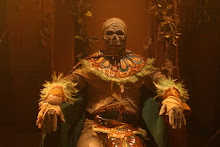
Here's a lengthy, detailed critique of your favorite reanimated Aztec mummy's blog - a critique that actually manages to sound sensible and nuanced.

Naturally, we at RandZapper disagree with the critique, but at least the author attempts to separate himself (and his philosophy) from the nonsense often proffered in Objectivism's name.

We think that in drawing this distinction, the author overstates his case. It's quite obvious, for instance, that John Lewis was advocating the use of nuclear weapons in the article we quoted, even if he didn't come straight out and say it. Leonard Peikoff, pontificating on The O'Reilly Factor a few years ago, advocated the use of battlefield nukes without specific presidential authorization (prompting the astonished host to dub him "Dr. Strangelove"). And the quotes we take from newsgroups are not from outliers, but mainly from the oldest and most prominent Objectivist discussion group on the Web.

Still, it is good to know that not all Randians favor blasting the planet to kingdom come just to make a point.

The author also overreaches when he argues that Ayn Rand didn't want loyalists, but independent thinkers who would use her philosophy as a means to their ends. This may be what Rand said, but as Groucho would have put it, "Who ya gonna trust - me or your lying Ayn?" In her actual practice, as opposed to theory, Rand surrounded herself with sycophants, became enraged over petty disagreements, required her followers to undergo psychological therapy if they doubted her doctrines, excommunicated anyone unwilling to follow this regime, and ended up virtually alone because she had alienated nearly all her friends and allies. Today you can easily find online Randists competing with each other to prove which one boasts the most comprehensive recall of their goddess's sacred works - line by line, and word by word. The Objectivist movement is a herd of independent minds.

Sadly, there is no mention of the Randians' fascination with the word "savages" and their evident desire to expunge said savages from the Earth by any means necessary. But we acknowledge that no critique can cover everything.

Anyhow, read it for yourself. We are happy to provide a link to a Randist who has something intelligent to say. If only he were not such an isolated case!

(Those who wish to read the rationale for RandZapper's strategy of quoting only the most extreme comments made by self-identified Objectivists can find it here.)

Monday, August 27, 2007

Fascist schmacist

Greetings, RandZapper fans! Yes, it's been a while. Frankly, RandZapper has grown bored with the blood sport of trolling Google Groups in search of idiotic comments by Ayn Rand smoochers. There are only so many variations on the basically stupid, sometimes genocidal, occasionally racist remarks spouted by these undereducated intellectual wannabes.

Recently, however, we did find one promising thread entitled Fascism and Objectivism. It begins,

I have noted that there has been, at various times, a charge of fascism leveled against Objectivism, or particular Objectivists, including Ayn Rand herself. Could someone here explain to me what they feel is the source of such accusations? Even if you disagree, you must have some idea of what part of the philosophy or Ayn Rand's writings inspire such charges?
Christopher Roberson takes up the challenge in fine fettle:
I can think of three likely targets:

1. Her hectoring intellectual style. Calling people who disagree with you "irrational" and "thugs" is not very endearing. This is not political fascism, of course.

2. Her heroes are almost all tall, blue-eyed Nordic types; her villains are generally pudgy, fussy, dark-haired little men. For decades, the latter was a common stereotype that allowed writers to hint that the villain was a Jew. Rand, of course, was Jewish herself, so at most she can be accused of being a self-hating Jew, if that.

3. Her aesthetics are pretty much identical to Fascist aesthetics. I'm referring to the sort of art that was idealized by the Fascist regime in Italy and the Nazi government in Germany. They both had pronounced affinities for Romanticism.

There are three reasons for you, none of them political.

Appalled by this outbreak of honesty, Dean hastens to reassert the Objectivist orthodoxy:
This is an age of extensive moral relativism and subjectivism. Ayn Rand said (and proved) that we can be objective and certain, in all areas of knowledge. She did not hesitate to apply that principle to moral evaluation in particular. To relativists and subjectivists, claims to objectivity and certainty regarding how people ought to think and act, and how they ought to be evaluated, sound like authoritarianism....
Get that, people? We can be objective and certain in ALL areas of knowledge. Rand PROVED this.

Cool.

Next, Mike weighs in:

The problem began with Rand's "indirect" means of characterization in her novels, giving heroes as archetypes rather than as folks dealing with their own self-doubts, moments of cowardice as well as those of courage. This combined with her lack of empathy for the numerous villains she uncovered in real life, giving her attitude towards those she disagreed with a sense of self-righteousness, of "you are wrong and I have no better solution to give," that is fundamental to fascism. This was not her attitude, in the main, but ...
Hold on. It wasn't?
As her movement progressed, she became consumed with the idea of creating a New Order, where folks thought the right thoughts and behaved the right way. Books were rated as to how closely they were "Objectivist." Reading the "wrong" material was discouraged unless one's stated purpose was to "integrate" it with the truths Rand discovered--i.e., reading for new knowledge from the wrong people, knowledge that could upset the prevailing system of ideas, was actively discouraged. "Loaded" language was used, so that "selfishness" or "rational" or "capitalism" acquired new meanings, the better to inculcate Objectivists with the idea that they had inherited a Special Truth unknown to others. People who disagreed with her were excommunicated. People who were in doubt were given "philosophic therapy" by Branden, with her active approval. The notion of a New World Order fashioned by a charismatic leader who supposedly has no inner doubts as he or she tinkers with the lives of others--that is all compatible with the idea of a Fascist society.
Absolutely true, and well stated.
Rand's actual *ideas* lay almost buried beneath the insults bandied back and forth. Happily, they are always available to the person interested in picking up her books and willing to put forth the energy to read between the lines.
Sigh. Mike, Mike, Mike, you had us, then you lost us.

Rand's "actual ideas" are entirely consistent with her narcissistic, authoritarian, intolerant, petulant, judgmental, tyrannical behavior.

Still, you were making good sense there for a while.

The discussion then gets sidetracked into an argument about whether Rand's heroes were really "almost all tall, blue-eyed Nordic types." Someone brings up Francisco D'Anconia as a counterexample. Someone else deftly pulls up this quote from the Bible - er, excuse us, we meant Atlas Shrugged.

Nobody described [Francisco's] appearance as Latin, yet the word applied to him, not in its present, but in its original sense, not pertaining to Spain, but to ancient Rome...His features had the fine precision of sculpture. His hair was black and straight, swept back. The suntan of his skin intensified the startling color of his eyes: they were a pure, clear blue.
"I guess he's as un-Latin as you can get, for a Latin dude," the poster remarks churlishly - and accurately.

Dean, who apparently can be counted on to spew Randian boilerplate on demand, gives his two cents:

By induction, Rand had no particular fixation on Nordic heroes. [RandZapper loves "by induction." It sounds so darn philosophical.] Roark, by name and red hair, was implicitly of Irish extraction. D'Anconia was decidedly of Mediterranean extraction. We can grant you Rearden and Ragnar, but not as some concession toward a faulty identification. [What in Galt's name does that mean?] ...

The description of Galt provided earlier in rebuttal to your hasty imputation describes an obviously non-Nordic physical type. If anything, Rand's description is in line with making him a new and perfect kind. Being a real person, he had to have some specific appearance. But Rand pointedly made him _not_ physically or ethnically specific. His character was man the ideal type. She symbolized this by making his appearance _not_ suggest anything specific to what we are familiar with already. She chose to portray him as _not_ a Nordic (or any other) instance of man.

There is much weirdness in this comment, but above all note the admission that Galt, Rand's portrait of the human ideal par excellence, bears no relation to any recognizable kind of human being.

Someone politely challenges Dean to back up his earlier statement that Rand proved that we can be objective and certain in all areas of life:

Hey, Dean, I'm wondering if you would do me a favor? Would you provide a cite (small or large, I'll do what it takes) where Ayn Rand *proves* stuff like this.
While we hold our breath awaiting Dean's response (which never comes), let's read excerpts from a series of posts by Matt Ruff. He makes a number of dazzle shots:
Rand's description of James is interesting: "He looked like a man approaching fifty, who had crossed into age from adolescence, without the intermediate stage of youth. He had a small, petulant mouth, and thin hair clinging to a bald forehead. His posture had a limp, decentralized sloppiness, as if in defiance of his tall, slender body, a body with an elegance of line intended for the confident poise of an aristocrat, but transformed into the gawkiness of a lout..."

It's as if Rand were saying that James, as Nat Taggart's son, was genetically predisposed -- "intended" -- to be a right-thinking capitalist (i.e., an attractive man), but he blew it, and now nature has retaliated by robbing him of his good looks. By the way, his eyes aren't blue. They are "pale and veiled." Socialist ideas, it seems, can affect even the tint of one's irises...

I can think of a fourth [reason for seeing Randism as fascistic]: the apocalyptic/messianic theme of "Atlas Shrugged." The rational individualists don't just triumph in the end, they triumph *utterly* -- the implication is that most of the evil collectivists will be destroyed in the final collapse of civilization, and those who survive are so weakened and so scattered that they'll pose no problem when the individualists return to rebuild. As Galt says in his speech: "Those who choose to join us, will join us; those who don't, will not have the power to stop us; hordes of savages have never been an obstacle to men who carried the banner of the mind." ... [This quote] sounds like a rallying cry for a pogrom....

Rand's actual beliefs were markedly different from those of Christian fundamentalists. Her *way of believing*, however, was quite similar -- i.e., she believed that she was in possession of the absolute truth, that this was obvious to any reasonably intelligent person, and that therefore anyone who persisted in disagreeing with her after hearing her arguments was exhibiting bad faith.

Chris Roberson, annoyed by the obsessive search for Randian characters who don't match his generalization in every detail, blurts out:
Christ almighty, the nits you people pick.

No, not ALL her villains match anti-Semitic stereotypes. Some do, though, and quite noticeably. Pointing out that some of them lack some of the stereotypical features does not constitute a refutation of my claim.

And not ALL her heroes are Aryan types. But most are. Even the multi-cultural mix of heroes in _Atlas Shrugged_ have pretty much the same set of features, with minor details thrown in here & there to differentiate them, much like the actors on soap operas.

It may be going too far to call the cast of Atlas "multicultural," but of course, the absence of blacks, Asians, native Americans, etc., may be more symptomatic of 1950s culture in general than of anything in Rand's psyche. (Then again, wasn't AR supposed to be the kind of world-historical, once-in-a-millennium genius who could transcend the limitations of her culture?)

Matt Ruff again:

If it makes you feel any better, Chris, I think your point is more or less accurate as well: in "Atlas Shrugged," physical beauty correlates very strongly to moral worth. I see the same parallel to anti-Semitic propaganda that you do. No, Rand is not explicitly racist (the occasional stray comment about green-toothed Arabs excepted) but I do get the sense reading her character descriptions that good and evil are largely intrinsic qualities, and that with a few very minor exceptions, her heroes and villains are locked into their roles at birth. If that's true--if villains are villains by nature, and cannot be "cured" or reformed, then the only thing to do is root them out and destroy them. And if everyone who disagrees with Rand's philosophy is a villain...

[T]hey definitely are stereotypes of the kind used to justify totalitarian/fascist policies. Maybe what's leading you astray here is the fact that historically, fascist propaganda did (and still does) often make use of anti-Semitic themes. But even if it didn't, it would still be fascist propaganda. Scapegoating people for their political or philosophical beliefs is no better than scapegoating them for their ethnic or religious background.

Iván Ordóñez finds fault with "Rand's archaic, Eurocentric conception of physical beauty."

Prompting a certain John - not Galt, we presume - to respond in full snark mode:

Oh yah, those horrible Europeans that brought us logic, science, Renaissance art, scientific engineering and the rights of man. Gee, what a travesty that they ever existed. We need jungle savages and strange mystical rituals!
Ah, jungle savages. Like nukes and Hitler, sooner or later they will inevitably make an appearance in a Randian thread.

Jim Klein quotes the above paragraph and goes for the jugular:

This would seem to confirm Ivan's charge, in view of the facts a) that you attribute "logic, science, Renaissance art, scientific engineering and the rights of man" exclusively to Europeans, a rather far-fetched claim at best; and b) you loosely imply that there are two sorts of folks in the world---Europeans and jungle savages.

I wonder...upon consideration, would you choose to reword that comment? If so, I think you ought to. If not, why not?

In his rebuttal John demonstrates his encyclopedic grasp of history:
Art [was found in other cultures], yes, but the art wasn't on the scale of renaissance art. Science, logic and scientific engineering definitely not. These were exclusive to the West and the *reason* the West rose as it did.
Let's unpack this, shall we? Non-Western art is not on the scale of Renaissance art? So the pyramids of Egypt and Mesoamerica were smaller than St. Peter's Cathedral? Or does he mean non-Western art is not as good? Well, that's debatable, surely.

How about science, logic, and scientific engineering? Exclusive to the West, did he say? Has he ever heard of the Great Wall of China (it's hard to miss; you can see it from outer space) or, again, the pyramids? Or the massive engineering projects carried out by the Inca, Aztec, Olmec, and Maya? How about the invention of gunpowder, the written word, and the number zero? How about ...

Oh, never mind.

Luckily, Chris Roberson jumps into the fray to make the obvious (but necessary) points. Here's his little dialogue with John.

John: I use the term "jungle savages" because the ideas of these cultures are precisely what multiculturialists [sic] like to raise up as if they are equal to the West. African studies are supposed to be on a par with Western studies.

Chris: So by "jungle savages" you mean Africans? (Does anyone else see the implications of that phrase starting to surface here?) ... I'm really not following your argument. There are jungles in Africa, but they don't cover much of the continent. The vast majority of Africans have never seen a jungle. And many of the cultures in Africa have been literate for a very long time.

John: I don't know what your point is by this, surely you realize I'll blow you out of the water if you want to actually delve in depth into a specific culture and then try to compare it with the West. Or maybe you aren't, which would be pretty sad. [This reminds RandZapper of David Ramsey Steele's observation, cited often on the ARCHN blog: "The doctrinal structure of Randism is bluff, buttressed by abuse of all critics."]

Chris (calling his bluff): Ooo, I'm really shaking now. Sure, let's talk about a specific culture. How about Tokugawa-era Japan? ... Golly, let's see... India? ... Maybe we should talk about African culture, since you mentioned it. Do you mean North African or sub-Saharan African culture? Probably sub-Saharan, since North Africa doesn't have any jungles, and it's been a literate area for millenia. So is it sub-Saharan African culture you want to single out as particularly pathetic in comparison to the West? As my post should indicate, I am not sure exactly what your overall thesis is. Is Western culture better in almost all respects than all others? Or is there some particular aspect of Western culture that stands out? Visual art? Music? Philosophy? Literature? Or all of the above?

John (backing away from his promise to argue specifics and retreating into every Randist's specialty - generalized abuse): I'm sorry that it's going to take *this much* to explain to Christopher. There are certain things I take for granted when I explain any subject. For instance, when I describe how a car works I don't usually think I'm going to have to describe the tensile strength of the metal, or the fact that they are faster than chariots. But, with some people you have to explain *everything*, and this makes for tedious work. Chris is a modern philosopher, which rather explains a lot.

Chris: Oh ha ha. I'll note that your long disquisition that follows doesn't really explain what you mean by 'savagery', which is what I was interested in hearing about.

John (still avoiding specifics): First, Chris has got to look at the big picture. He has to see that the West has done fantastic things on a scale that no other culture has come close to. I think it is a matter of basic honesty to note this.

Chris: Sure, of course the West has done fantastic things on a remarkable scale. ... But I'd also suggest (and I think you'd agree) that the West's most singular achievements have been as a result of its scientific and technological supremacy. Other cultures in the world can easily rival Western achievements in pre-modern art, architecture, music, and organization, to mention only a few categories of cultural achievement. Think of Japanese visual art, the Taj Mahal, Indian classical raga, and the Great Wall of China as representative examples.

John (bullshitting desperately in vague generalities in a futile attempt to disguise his lack of learning): Science and logic had their beginnings in the West. The great art and engineering that followed were in the West. The idea of the rights of man was a Western concept which arose form science and logic, and from the concept of rights rose a division of labor society, and unbelievable levels of wealth and prosperity for everyone, with no end in sight.

Chris (easily seeing through his act): Here's where I think your potted history of Western Civ is a little off. Aristotelian logic had its beginnings in the West, but logic (and even a fair amount of basic science) preceded modern technology by many centuries. It's not clear to me that there was any simple causal connection between the two. Consider, for example, that Arab philosophers and mathematicians were the ones who kept Aristotelian logic alive during the Dark Ages. But the Arabs were not the first to develop modern technology (though of course they did invent the concept of zero & pioneer modern astronomy).

And, uh... the division of labor society was quite far advanced long before the Rights of Man were heard of. I think your causal ascription may be backward, frankly.

John (in full retreat mode and sweating hard): Forget the phrase "jungle savages", because it is *not* the point. [It isn't? RandZapper is confused.] ...

Chris: Well, if the phrase "jungle savages" is not the point, here's a bit of unsolicited advice: try to avoid using it. ... To someone who doesn't know you, well: "jungle savages" sounds pretty straightforwardly racist. And if you don't want to give that impression, which you probably don't, you shouldn't use the term.

Hmm. Yes, really, y'know, if you don't want to come across as an ignorant, closed-minded, atavistic racist, you probably should avoid throwing around terms like "jungle savages." Good point. Funny how the Randians never seem to pick up on it, no matter how many times they are told.

Why, it's almost as if the division of the human race into elites and savages is a fundamental part of their worldview. (Quoth Galt: "Hordes of savages have never been an obstacle to men who carried the banner of the mind.") And since the earth apparently cannot long endure half-rational and half-savage, there must be a solution to the problem posed by the savages. A solution that will end the problem once and for all. A final solution, we might say. Sort of like in the Bible, er, we mean Atlas Shrugged, when the savages die or waste away at the end and only the elites are left to repopulate the world. You can see them coming down from the mountaintop, Rand's tall, classically featured, Eurocentric, white-collar whitebread Ubermenschen, ready to clean out the dross of humanity like Hercules disinfecting the Augean stables, prepared to expunge the earth of all its subhuman filth and build a new, better, dare we say purer world ...

Gosh, why would anyone accuse Rand of fascism? It's a head-scratcher, all right. It's got us beat. It really does.

Tuesday, May 15, 2007

Encore!

Far be it from us to beat a dead horse, but we could not resist a few more quotes from the redoubtable Bob Kolker, previously profiled here and awarded the considerable honor of induction into the Randzapper Hall of Fame.

It now has come to our attention that Kolker the Joker was banned from the Web site TalkOrigins. The moderator explains that Kolker was banned "for posting stuff like this." He then links to two vintage Kolkerian diatribes, one of which appeared on TalkOrigins (a site normally concerned with controversies about evolution).

In the first rant, Kolker observes,

The threat of atomic holocaust has a remarkable effect on the clarity of thought. The idea is to make it plain to the world : do it our way or we will kill you.
Asked how his brand of slaughter differs from that of the Muslim extremists he condemns, Kolker replies,
It is good-guy bloodthirsty vs. bad guy bloodthirsty. These goat fuckers started with us and we will finish ... If thine enemy smite thee on thy cheek, rip his head off and shit down his neck. Whatsoever any do unto you, do unto him likewise tenfold. We have got to end this turn-the-other cheek and forgive thine enemy crap. Here is the right way to live. Help and cherish your friends, destroy your enemies and be polite to the neutrals. Christial [sic] morality is absurd and just plain dangerous. If we practice it, we will die.
Since this is not an Objectivist Web site, there are sensible people on it. One of them responds to Bob the Butcher:
If it comes to pass that your way of thinking prevails, I will be joining those who will destroy you and the "America" you represent. I'll rather enjoy shitting down your neck.
This comeback has the remarkably salutary effect of largely shutting up the Bobster for the rest of the discussion.

Then there's rant number two:

Time to nuke the Muslims abroad. The principle is very simple. You cherish and protect your friends. You destroy your enemies and be polite to the neutrals. We will have to be more subtle in North America but at least we will have to round the Muslims up and deport them to a killing zone. Then kill them. I imagine that some infants could be saved. Prior to being infused with the Jihad/Martyrdom meme Muslim youngsters are no different from any others.
This rant is found in an Objectivist discussion group, so the quality of repartee is accordingly much lower. Kolker has the opportunity to spurt more venom:
I want the Muslisms [sic] in this country to be afraid. Very afraid. Its [sic] their turn to be on the Death Lists.
Niiiiice.

You can see why this guy is Hall of Fame material!